
Foundation Repair in Houston, TX
Engineer-directed foundation repair for slab, pier-and-beam, and post-tension foundations affected by Houston's shifting clay soils.
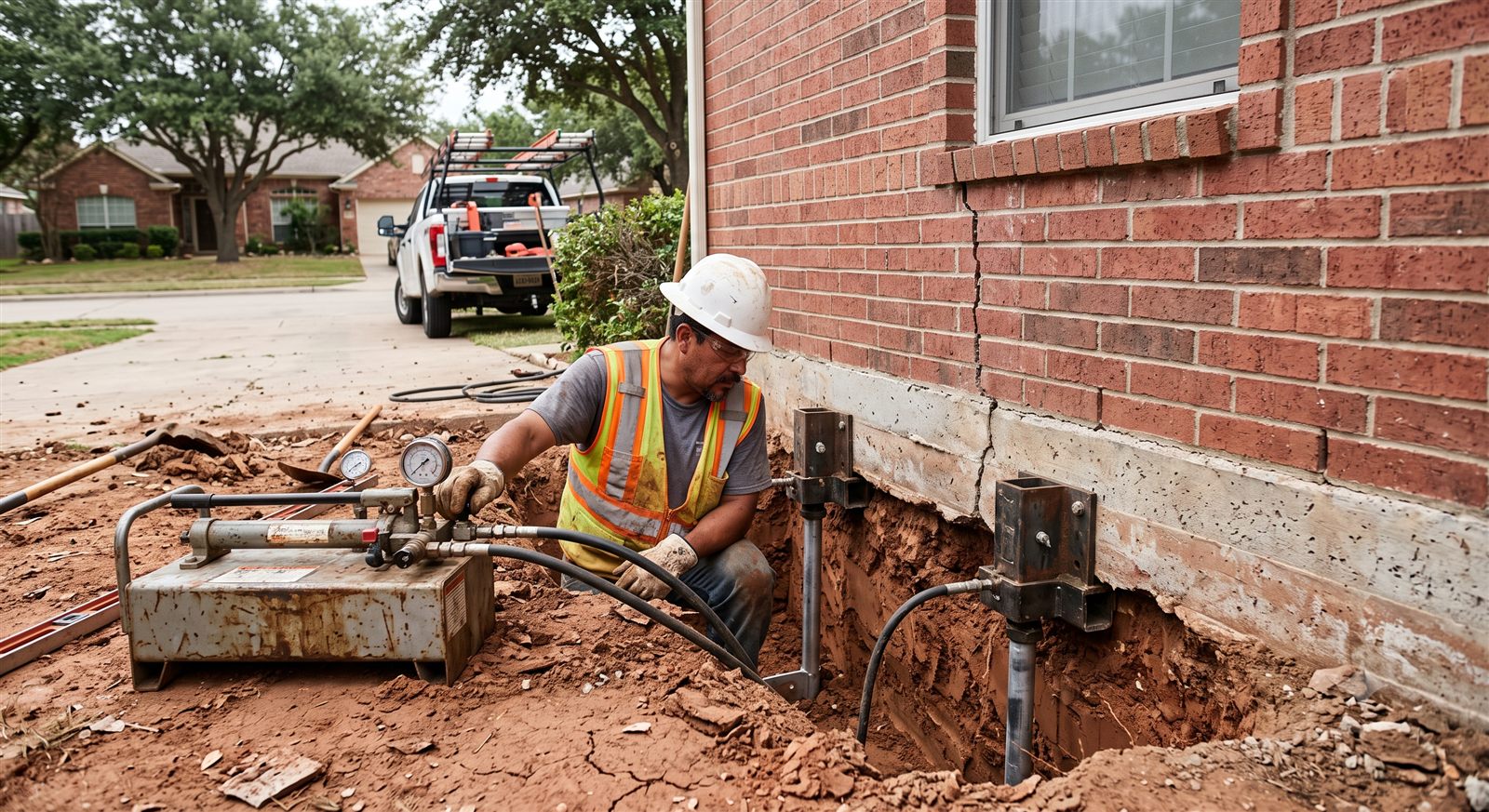
- ▸Independent engineering evaluation first: elevation survey, crack mapping, drainage and plumbing review, written report.
- ▸We don't sell piers. Sometimes the answer is drainage, a plumbing leak, or watchful waiting.
- ▸Evaluation and report: a few hundred dollars. Repairs range from a handful of piers to whole-house stabilization.
- ▸Report within days of the visit; most pier jobs take days, not weeks.
- ▸Licensed to design the repair and to build it, or to hand a defined scope to your own contractor.
Houston sits on some of the most reactive clay soil in the country, and that soil moves with every wet and dry cycle. Over time that movement shows up as cracked slabs, doors that stick, and foundations that settle unevenly from one corner of the house to the other.
We diagnose the cause before recommending a fix. Soil movement, plumbing leaks, poor drainage, and tree root intrusion each call for a different repair strategy. Our evaluations are engineer-led, not sales-led, so the repair plan is sized to the actual problem instead of the most profitable one.
Where repair is warranted, we specify the leveling method, pier spacing, and depth based on soil data for your lot, then inspect the completed work against that spec.
Why Houston foundations move
Most of the Houston metro sits on a thick layer of expansive clay. It's the same stuff that makes the yard turn to soup in March and split open in August. When that clay takes on water it swells, and when it dries out it shrinks, and the difference between the two states can be several inches of vertical movement at the surface. A house doesn't float above that. It rides on it.
The movement is never even. Soil under the middle of a slab stays damper than soil around the edges, because the house shades it and keeps the rain off. The side of the house with the big oak dries out faster than the side without, because the roots are pulling water all summer. The corner near the downspout that dumps onto the flowerbed stays wetter than the corner that drains to the street. One part of the foundation rises while another drops, and the house twists slightly to follow it.
That twisting is what you see as cracks. Drywall splits at the corners of doors and windows because those are the weak points in a wall. Doors stick because the frame has gone out of square. Brick veneer cracks in a stair-step pattern along the mortar joints because brick can't bend. None of it means the house was built badly. It means the house was built on Houston clay, and the clay has been doing what clay does for a few decades.
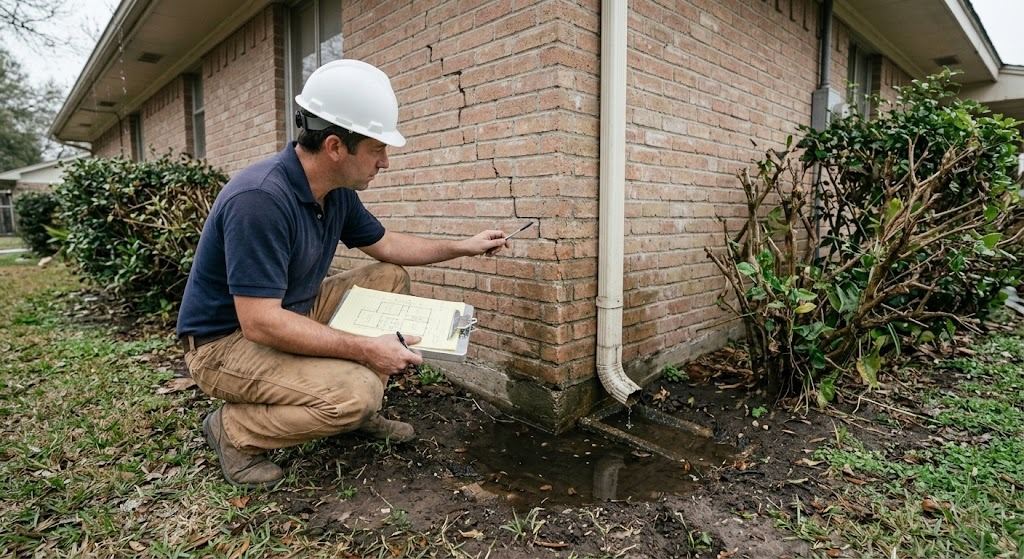
The usual suspect: a downspout dumping against the foundation, saturated clay on one corner, and the stair-step crack that follows.
An evaluation from someone who isn't paid by the pier
Most people who call us have already had a foundation repair company out. They got a diagram with dots on it, a pier count, and a price. Sometimes two companies came out and the dot counts were very different.
Repair companies aren't dishonest. Their tool is piers, and when your tool is piers every foundation looks like it needs some. We don't sell piers. We evaluate the foundation, work out why it's moving, and tell you what, if anything, to do about it. Sometimes that's piers. Often it's drainage. Sometimes it's a plumbing leak under the slab that has been softening the soil for years, and no pier job will hold until it's found. And sometimes the movement is within normal range for a Houston house of that age, and the right move is to watch it.
The evaluation covers four things:
- Elevation survey across the whole floor with a manometer or laser level, to a tenth of an inch, so we know exactly where the slab is high and low.
- Crack mapping, noting direction and width, because the direction tells you which way the foundation is going.
- Drainage, grading, trees, gutters, and plumbing, which is where the cause usually lives.
- A written report you can use however you like, including to get competing bids from repair contractors on a defined scope.
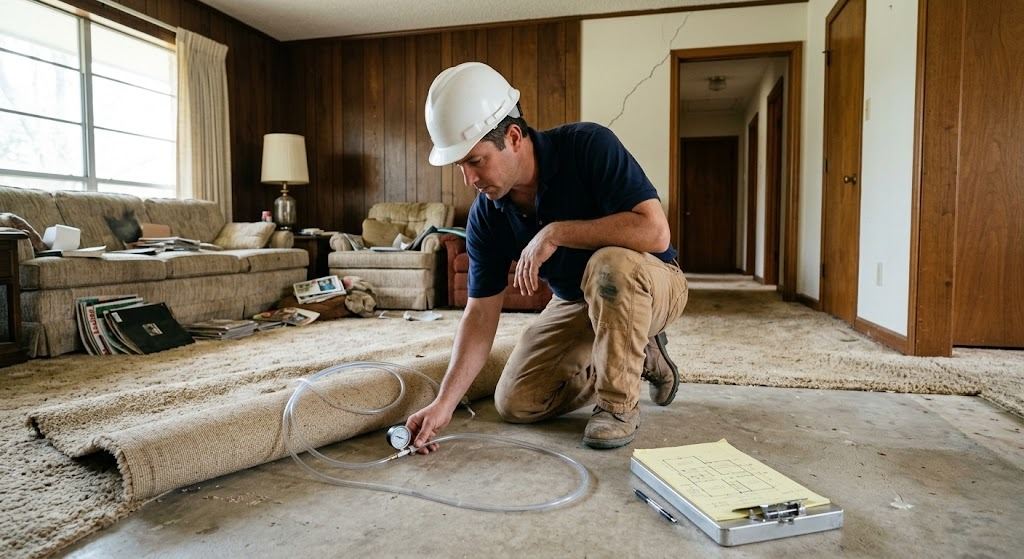
An elevation survey: readings across the whole floor, plotted on a grid, so the diagnosis is measured rather than eyeballed.
Which foundation you have changes the repair
Slab-on-grade is what most Houston houses built since the 1960s sit on. A single pad of concrete with beams formed into the underside, poured directly on the prepared soil. When it moves, the whole slab tilts or bows, and the repair is usually to lift the low side back onto piers driven to a stable depth and hold it there.
Pier and beam is the older system, common inside the Loop and in the pre-war neighborhoods. Wood beams sit on concrete or masonry piers over a crawlspace. These move differently. Individual piers settle or heave, the beams sag between them, and the floor above develops soft spots and slopes. The repair is often to add or reset piers and shim the beams back to level, and because you can get under the house, it's usually less invasive than slab work. Crawlspace moisture is what quietly ruins these over time.
Post-tension slabs arrived in Houston subdivisions in the 1980s and are standard in most newer construction. Steel cables run through the concrete under tension, which makes the slab stiffer and better at bridging soft spots. They still move, but as a unit rather than cracking through. You can't cut or core into one without knowing where the cables are, so the repair approach is specific. If your house was built after about 1985 and you don't know which slab you have, that's one of the first things we'll establish.
The repair methods, and when each one fits
Which method suits your house depends on the soil on your lot, how deep the stable layer is, what kind of foundation you have, and what's causing the movement. That's the engineering question, and it decides whether a repair lasts or needs redoing.
- Pressed concrete pilings: the most common Houston repair. Concrete cylinders are hydraulically pressed under the foundation, one on top of the next, until the soil stops giving, then the slab is lifted onto them. Cost-effective and effective in much of the metro, but in some areas they never reach anything stable.
- Steel piers: pipe sections driven thirty feet or more to load-bearing strata or refusal. More per pier, and the right answer where the clay is thick enough that pressed pilings would just sit in more clay.
- Drilled bell-bottom piers: a shaft drilled and belled at the bottom, filled with reinforced concrete. Slower and messier, very durable, still right in some situations.
- Mudjacking or polyurethane injection: lifts a slab that settled evenly without structural distress. Not a fix for an active problem.
- Root barriers: stop a large tree from drying the soil under one side of the house each summer.
- Drainage and plumbing: regrading, extending downspouts, or repairing a leaking sewer line under the slab. Addresses the cause instead of propping up the symptom, and a good share of the houses we see need this rather than piers.
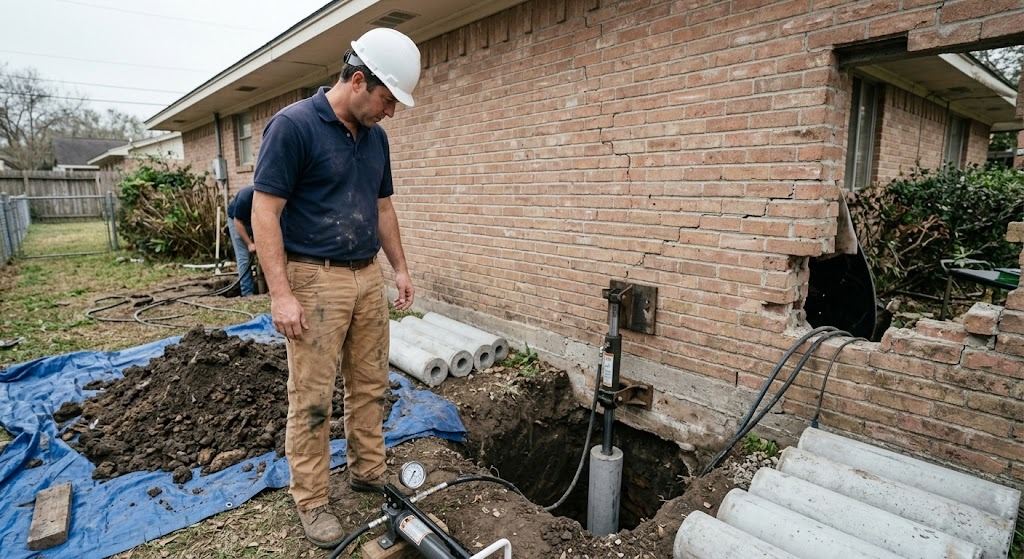
Pressed pilings going in under the grade beam. The depth they reach, not the count, is what decides whether the lift holds.
What we do on a foundation repair job
It starts with the evaluation described above: elevations, crack mapping, drainage and plumbing review, and a written report. If the report says repair is warranted, we design it. That means specifying the pier type, the locations, the spacing, and the target depth, based on the elevation survey and what we know about the soil on your lot. The design is stamped, which matters for the permit and for your records later.
We hold a general contractor's license alongside the engineering, so we can perform the repair ourselves. The crew works from our own drawings, we're on site during the lift, and we take elevation readings after to confirm the slab landed where the design said it would. If you'd rather use a repair contractor you already trust, our design becomes the scope they bid on, and we can inspect their work when it's done.
After the lift, a foundation repair almost always needs some follow-up: cosmetic repairs to the drywall and brick, sometimes a plumbing test to make sure nothing under the slab was strained by the movement, and a drainage fix if that was part of the cause. We tell you what to expect before the work starts so none of it is a surprise.
Costs, and why the pier count matters more than the price per pier
An engineering evaluation with a written report runs a few hundred dollars for a typical house. That's the number to compare against the repair quotes you've been given, because it's usually a small fraction of one of them, and it's the thing that tells you whether the quotes are for the right work.
Repair costs in the Houston area are mostly a function of pier count and pier type. Pressed pilings are the least expensive per pier; steel piers cost more. A partial lift on one corner of a house might be a handful of piers. A whole-house stabilization can be dozens. The spread between a small job and a large one is wide enough that a per-pier price on its own doesn't tell you much. What matters is whether the count is right, and a pier count from an engineer who isn't selling the piers is the only way to know.
Drainage and plumbing fixes are usually far cheaper than piering, which is one of the reasons it's worth finding out whether that's the actual problem before committing to a lift.
Selling, buying, or filing a claim
A lot of foundation evaluations happen because a house is changing hands. A buyer's inspector flagged the foundation, the buyer wants to know if it's a real problem or a Houston problem, and the seller wants to know the same thing before agreeing to a price cut. Our report answers that question for both sides. It says what the elevations are, whether the movement is active or historic, and what, if anything, needs to be done. Realtors on both sides of a deal use it to settle the question and move on.
Insurance claims are a separate situation. Most Texas homeowner policies exclude foundation movement from soil, but they often cover foundation damage caused by a plumbing leak, and telling those two apart is exactly what an engineering evaluation does. If a claim is on the table, the report needs to be written with that in mind, and we know what adjusters look for.
How long it takes
The site visit for an evaluation usually takes an hour or two, depending on the size of the house and how much of the floor is accessible for elevation readings. The written report follows within a few days. If a real estate deal is waiting on it, tell us, and we'll work to the closing date.
The repair itself is faster than most people expect. A typical residential pier job, from mobilization to the lift and cleanup, is a matter of days, not weeks. Larger jobs with a lot of piers or interior work through the slab take longer. Weather matters, because the crew is digging, and a week of heavy rain can push the schedule. Drainage and grading corrections can usually be done alongside the pier work rather than as a separate project.
Permits for foundation repair are required in most of the metro and are generally quick to obtain, since the engineering is already stamped when the application goes in.
When to call, and when it can wait
Ordinary Houston house behavior, usually fine to watch: hairline drywall cracks that don't grow, a door that sticks in August and closes in January, a crack in the garage slab. Note when you first saw them and move on.
Worth a look:
- Cracks getting wider, wide enough for a coin, or running diagonally from the corners of doors and windows.
- Cracks in several rooms at once, or paired with doors and windows going out of square.
- A stair-step crack in the brick that opened recently.
- A floor you can feel slope when you walk it.
- A gap opening between wall and ceiling, or floor and baseboard.
- Anything that appeared suddenly after a plumbing problem, a big tree removal, or a long drought. The cause is still active.
Questions we hear often
Do you do the repair, or just the inspection?
Both. We evaluate the foundation and write the report, and if repair is warranted we can design and perform it ourselves as a licensed contractor. You can also take our design to another repair contractor and have them bid it. Either way the diagnosis comes from someone who isn't paid by the pier.
How do I know if the foundation company's quote is right?
You compare it to an independent evaluation. If two repair companies gave you different pier counts, at least one of them is wrong, and possibly both. An engineering report tells you where the slab actually is and what it actually needs, and then the quotes either match it or they don't.
Will foundation repair fix the cracks in my walls?
Lifting the slab closes some cracks and opens others, because the house is being moved back toward where it started. The drywall and brick still need cosmetic repair afterward. What the repair does is stop the movement so the cosmetic fixes stay fixed.
Is it normal for a Houston house to have foundation movement?
Yes. Nearly every house in the metro moves seasonally with the clay. The question isn't whether it moves but whether it's moving more than the structure can tolerate, and whether the movement is getting worse. That's what the elevation survey tells us.
Should I fix the drainage before or after the foundation repair?
Before, if drainage is part of the cause, and it often is. Piering a slab while water is still pooling against one side of it treats the symptom and leaves the cause running. Sometimes fixing the drainage alone is enough and the piers turn out not to be needed.
How long does a foundation repair last?
No one can promise a number of years on Houston clay, and you should be wary of anyone who does. What we can say is why repairs fail early: the piers didn't reach stable soil, the cause of the movement wasn't addressed, or the pier layout didn't match where the slab was actually moving. All three are design problems. A repair that gets those three right is the one that stays out of your life.
- ▸Cracks in drywall near doors and windows
- ▸Doors or windows that stick or won't latch
- ▸Sloping or uneven floors
- ▸Gaps between walls, ceilings, and floors
- ▸Cracks in exterior brick veneer, especially stair-step patterns
Foundation Repair across the Houston metro
A straight answer about what your house needs, not a sales pitch.
Call now or send a few details and we'll get back to you the same business day.